
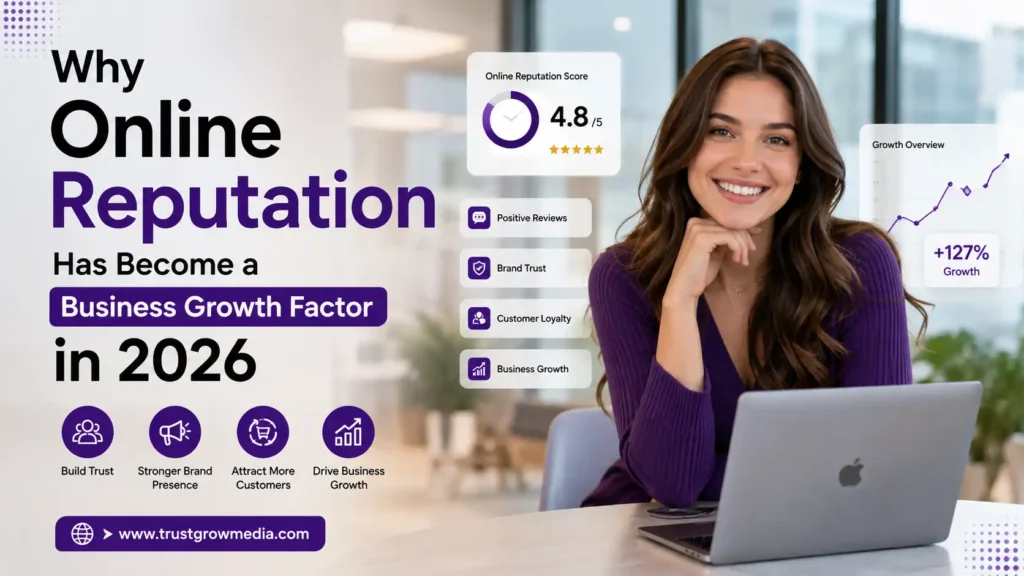
Discover why online reputation has become a business growth factor in 2026 and how it impacts your brand’s success. Read more in our latest blog!
Introduction
In the digital age, your online reputation is no longer a side issue. It is a direct business growth factor. Before potential customers call, visit, or buy, they often check search results, read reviews, and scan your social profiles. Those quick checks shape first impressions in seconds. If your brand looks trusted, active, and responsive, people feel safer choosing you. If it looks ignored or unclear, they may move on just as fast. That shift is why reputation matters more than ever in 2026. For businesses looking to build a stronger digital presence and protect their reputation, TrustGrowMedia can provide reputation-focused guidance and solutions.
The Digital Transformation of Consumer Behavior in 2026
Consumer behavior in the digital age has changed around speed, visibility, and trust. People now use your online presence as a shortcut for judging quality before they ever speak to you. Search results, ratings, and public comments help them decide whether your business feels reliable.
In this digital world, the impact of online reviews is hard to ignore. Buyers often look for signs that others had positive experiences. That is why online reputation is so important for business growth today. It reduces doubt early and helps you win attention before competitors do.

The Role of Social Media Presence in Shaping Perceptions
A strong social media presence affects how people read your brand image. When someone visits your profiles, they are not only looking at offers. They are checking tone, consistency, and signs of real activity. In many cases, your social media channels become part of your first impression.
The number of followers can influence perception, but it is not the only signal that matters. People also notice whether your business replies, shares useful updates, and posts regularly. In the digital world, steady activity often feels more trustworthy than silence.
So how can a business improve its online reputation through social media? Start by being present, responsive, and consistent. Highlight positive experiences, answer questions clearly, and keep your online presence current. That helps people feel they are dealing with a business that pays attention.
How Digital Platforms Amplify Brand Visibility
Digital platforms expand how often people can find and judge your business. Search engines, review sites, maps, and social pages all work together to shape brand visibility. If your business appears in several places, it feels easier to verify and more real to potential customers.
That matters because search results often act like a filter. People compare star ratings, comments, and profile activity before making contact. A visible online presence sends important information without requiring a sales pitch. It tells people others have noticed your business already.
Why is brand visibility on digital platforms critical for business success? Because visibility drives consideration. If people cannot find enough credible signals about you, they may never reach out. Strong placement across search engines and public platforms increases trust, attention, and the chance of being chosen.
Why Online Reputation Drives Business Growth
Online reputation drives business growth because it shapes what potential customers believe before they interact with you. In most cases, buyers do not start with a conversation. They start with public signals like ratings, reviews, and your overall brand image.
When satisfied customers leave visible praise, that proof lowers hesitation for others. It also makes your business appear active, trusted, and worth exploring. That is why online reputation is so important for business growth today. It influences trust early, and early trust often decides who gets the sale.
The Connection Between Reviews and Customer Confidence
Online reviews build customer confidence because they reduce uncertainty. When people see recent customer reviews, they feel they are learning from real experiences rather than polished marketing. That matters most when the buyer is unfamiliar with the business or the product.
Star ratings are especially powerful because they simplify decision-making. Many users will consider a local business only if it has strong ratings, and positive reviews often increase trust. In today’s digital age, even a small rating change can affect whether someone clicks, calls, or walks away.
So how do online reviews directly impact a company’s sales and revenue? They change buyer behavior before purchase. Better reviews can increase action, support higher spending, and improve conversions. Weak or missing feedback can do the opposite by making people question quality or consistency.
Social Proof as a Key Influencer of Buying Decisions
Social proof is a psychological phenomenon that affects buying decisions when people look to the actions of others for guidance. This happens most often when the given situation feels uncertain. If a buyer does not know what to choose, seeing what others chose can feel like the safest next step.
That influence shows up in customer reviews, testimonials, follower counts, and bestseller labels. These signals suggest that other people already trust the business. As a result, purchase decisions feel less risky. The behavior of others becomes a shortcut for judging value.
What are the main ways social proof shapes consumer buying decisions? It signals popularity, reduces doubt, and creates a sense that choosing the same option is the correct behavior. In crowded markets, that social influence can push hesitant shoppers toward action much faster.
Unpacking Social Proof for Modern Businesses
For modern businesses, social proof is more than a marketing phrase. It is a psychological phenomenon rooted in social influence. People often look around for cues about what is normal, trusted, or desirable, especially when they lack full information.
That pattern matters for business growth because digital platforms make those cues visible at scale. Reviews, shares, views, and testimonials all show what previous customers did or believed. Those signals help shape buying decisions by reducing uncertainty. Next, it helps to look at the specific types of social proof that carry the most weight.
Types of Social Proof That Impact Business Growth
Not all social proof works in the same way. Some forms are direct and personal, while others are public and scaled across platforms. For potential customers, the strongest signals are often the ones that feel easiest to verify.
Previous customers play a major role here. Their comments, ratings, and visible experiences help others judge whether a business is worth trying. In many cases, these cues act like digital personal recommendations and move buyers closer to action.
Common forms of social proof include:
- Customer reviews that describe quality, service, or reliability in detail.
- Star ratings that give a quick trust signal in search results.
- Personal recommendations that carry strong influence because they feel more direct.
- Visible user activity, such as follower counts or shared positive experiences, that suggests popularity.
Case Studies: Social Proof in Action Across U.S. Markets
Across U.S. markets, case studies show that social proof changes how people behave online. In e-commerce, businesses use reviews, certifications, and activity signals to replace the in-store cues shoppers would normally see. That helps buyers feel more certain before checkout.
For a local business, the impact of online reviews is often just as direct. Positive feedback can increase customer satisfaction signals, improve trust, and make people more likely to take action. Social platforms also amplified behavior during COVID-19, showing both helpful and harmful sides of group influence.
| Market Example | Social Proof Signal | Likely Effect |
| E-commerce store | Customer reviews and certifications | Reduced hesitation and stronger purchase confidence |
| Local business | Positive public feedback and ratings | Higher trust and more customer action |
| Social media campaigns | Visible actions of others | Faster spread of both helpful norms and risky behavior |
Online Reviews: The New Age Word of Mouth
Online reviews now function as digital word of mouth. Instead of asking only friends or neighbors, people read public comments from past buyers before making a decision. That shift gives every review more weight than many businesses realize.
Positive reviews support trust-building because they offer visible proof that others had a good experience. For many consumers, these comments feel almost as credible as personal recommendations. That is why reviews influence both trust and action, and why businesses must treat them as a core growth asset.
Google Reviews and Trust-Building with New Customers
Google reviews matter because they appear where many buying journeys begin: search engines. When new customers search for a business, they often see ratings, comments, and business details before visiting a site. That makes Google one of the first trust checkpoints.
Unlike closed feedback, these reviews are public and easy to compare. A strong rating profile helps customer trust because it suggests consistency across many experiences. For local business searches, this matters even more on google maps, where buyers are often ready to act fast.
What role do Google reviews play in building trust with new customers? They provide visible, third-party validation at the point of discovery. Alongside social media platforms, they help people verify that your business is active, credible, and worth contacting.
How Reviews Influence Sales and Revenue
Reviews influence sales and revenue by affecting how confident people feel before purchase. If buyers see strong customer feedback, they are more likely to move forward. If they see uncertainty, low ratings, or unresolved concerns, they may leave without buying.
Positive reviews can increase spending and conversions because they make the offer feel safer. Strong public feedback also encourages more clicks and inquiries. In contrast, negative reviews can interrupt that path by raising questions about service, reliability, or product quality.
The key point is simple: customer feedback shapes revenue before a customer reaches your team. Reviews affect traffic, action, and choice. Even modest rating improvements can lead to measurable gains, while ignored complaints can reduce momentum over time.
Brand Visibility in a Crowded Digital Marketplace
In a crowded digital marketplace, brand visibility determines whether people notice you at all. A business can offer great service, yet still lose opportunities if its online presence is weak or hard to find. Visibility is the bridge between reputation and discovery.
Search engine optimization supports that bridge by helping your business appear in the places buyers already look. When search visibility and the brand’s reputation work together, trust builds faster. That is why digital visibility is not just about traffic. It directly affects credibility, comparison, and customer choice.
Increasing Brand Visibility Through Smart Online Tactics
Improving brand visibility starts with making your business easier to find and easier to trust. In the digital world, that means showing up consistently across search engines, review platforms, and social profiles. Visibility grows when your information stays active and aligned.
Search engine optimization helps because strong search placement often signals authority to users. Public feedback, business listings, and fresh content can all support a stronger online presence. These smart tactics make your brand feel current and dependable.
Useful steps include:
- Keep business details accurate across search engines, websites, and review pages.
- Encourage recent customer feedback to strengthen public trust signals.
- Share helpful updates on social channels to support a stronger online presence.
- Use search engine optimization to improve how often your business appears in relevant search results.
Building a Consistent Social Media Presence for Better Recognition
Recognition grows when people see your business repeatedly in a familiar way. That is why consistency matters so much in social media presence. If your profiles are active, clear, and steady, people are more likely to remember your brand and trust what they see.
A simple posting schedule can help. It keeps your business visible without long gaps that make the account feel abandoned. Video content can also strengthen recognition because it gives people a faster sense of personality, service style, and credibility across social media platforms.
The number of followers may attract attention, but reliable activity is what supports trust. To improve online reputation through social media, stay consistent, respond when needed, and keep messages aligned across channels. Familiarity often becomes recognition, and recognition often supports action.
Strengthening Customer Confidence Through Effective Online Strategies
Customer confidence grows when your business looks attentive, transparent, and steady online. People trust brands that seem present and responsive, not silent or careless. That is where practical online strategies make a real difference.
A proactive approach to reputation management helps you shape trust before problems grow. When customers see active profiles, thoughtful replies, and visible signs of care, they feel safer choosing you. In the next sections, you will see how specific trust-building tactics and review handling can strengthen confidence even further.
Reputation Management Tactics to Enhance Trust
Good reputation management is really about reducing doubt. When people can see that a business listens, responds, and stays active, customer trust rises. The brand’s reputation becomes stronger because it is supported by visible behavior, not just promises.
A clear reputation management strategy also helps you act faster when feedback appears. This matters because delays can make small concerns look bigger than they are. Strong best practices create consistency, and consistency is what many customers look for first.
Useful tactics include:
- Monitor review platforms and social channels regularly for new feedback.
- Respond promptly and respectfully so customers see that concerns are taken seriously.
- Acknowledge mistakes when needed and explain the next step clearly.
- Maintain accurate public information to support a stable and trustworthy brand’s reputation.
Resolving Negative Reviews to Boost Consumer Confidence
Negative reviews can hurt growth if they sit unanswered. For a small business, public complaints may make new buyers question reliability or customer service. The issue is not only the complaint itself. It is also what your response says about how you handle pressure.
That is why resolving feedback matters. A calm, respectful reply shows correct behavior in a given situation. It signals that your business is willing to listen, fix issues, and protect customer satisfaction. Even people who never leave reviews notice that pattern.
So how can negative online reviews affect a small business’s growth? They can reduce trust, clicks, and conversions if ignored. Yet when handled well, they can also boost consumer confidence by proving that the business takes accountability seriously and responds with care.
Best Practices for Managing and Responding to Online Feedback
Managing customer feedback well protects your online reputation and improves how others see your business. People read not only online reviews, but also the way a business reacts to them. That makes response quality part of the customer experience.
The best practices are simple: stay prompt, stay personal, and stay professional. Thank people for positive reviews, address care concerns, and avoid defensive language. These habits show potential customers that your business values feedback and handles public communication responsibly.

Handling Positive vs. Negative Reviews Professionally
Positive reviews and negative reviews both deserve attention, but they need different response styles. With praise, your goal is appreciation and relationship-building. With complaints, your goal is to show calm customer service and a willingness to improve.
Online reviews shape public perception long after they are posted. A thoughtful reply can reinforce customer satisfaction, while a careless one can damage trust. That is why professional tone matters in every response, even when the feedback feels unfair.
Helpful practices include:
- Thank customers for positive reviews and mention a specific detail when possible.
- Respond to negative reviews without blame, anger, or rushed excuses.
- Show empathy, acknowledge the concern, and explain the next step clearly.
- Treat every public response as part of your customer service record.
Simple Steps to Encourage Positive Reviews
Many businesses wait passively for reviews, but a proactive approach works better. If you want more positive reviews, ask at the right moment and make the process easy. Satisfied customers are often willing to help, but they may need a simple reminder.
Timing matters. Requests are most effective shortly after a positive experience, when the customer still feels connected to the result. Clear links and short instructions reduce friction and make it easier to encourage feedback without pressure.
Simple steps include:
- Send a follow-up message after service and ask for honest feedback.
- Share direct review links so customers do not need to search for the page.
- Use social channels to highlight positive experiences and invite others to share theirs.
- Make review requests a regular habit instead of a one-time effort.
Frequently Asked Questions
Q: How can a strong online reputation encourage more customer loyalty and referrals?
A: A strong online reputation reinforces customer loyalty because satisfied customers feel more confident returning to a business that listens and responds well. Positive customer feedback also makes personal recommendations more likely. When people trust your consistency, they are more willing to refer others and stay connected over time.
Q: What role does social media engagement play in ongoing reputation management?
A: Social media engagement supports reputation management by showing that your business is active, responsive, and aware of customer concerns. Regular interaction across social media channels strengthens your online presence and helps shape a more reliable brand image. People notice when a business communicates instead of disappearing.
Q: Can a negative review permanently damage a small business’s growth prospects?
A: A negative review does not have to permanently hurt a small business or its growth prospects. The bigger risk is ignoring negative feedback. With a proactive approach, a business can respond well, correct issues, and show potential customers that it takes service and accountability seriously.
Conclusion
In conclusion, a strong online reputation is no longer just an optional asset for businesses; it has become a crucial factor for growth in today’s digital landscape. As consumer behavior continues to evolve, the importance of managing your online presence cannot be overstated. From leveraging social proof to effectively handling reviews, every action contributes to building trust and confidence among your customers. By prioritizing your online reputation, you not only enhance brand visibility but also encourage customer loyalty and referrals. Start taking control of your online narrative today! If you need assistance, don’t hesitate to reach out for guidance on how to elevate your business’s online reputation.