

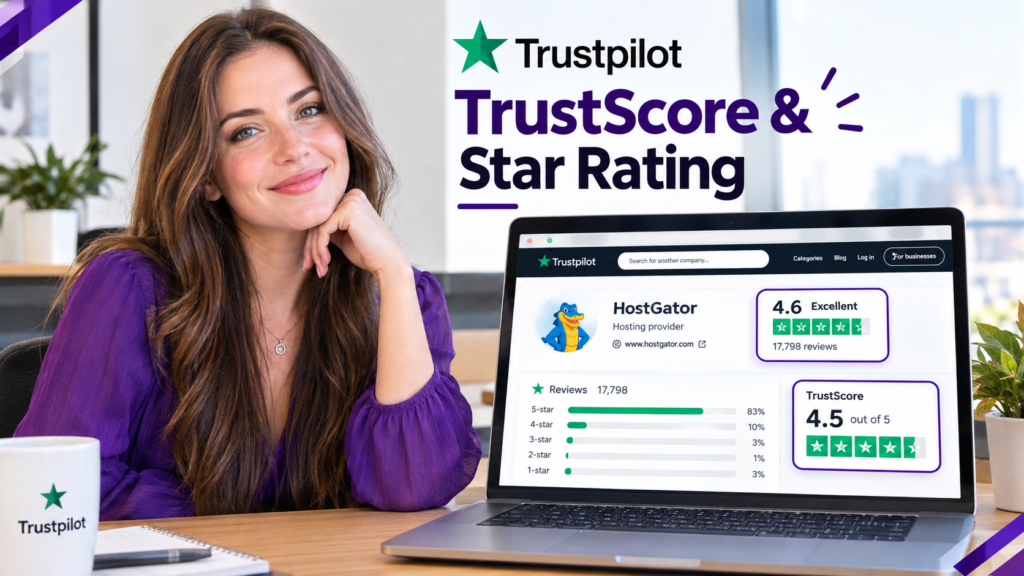
Trustpilot’s TrustScore is a dynamic measure based on the star ratings customers leave in their reviews. However, it is not simply the arithmetic average of all star ratings. Trustpilot uses a weighting system that considers factors such as the number of reviews and how recent they are, giving newer customer experiences greater relevance. Trustpilot also incorporates a balancing component equivalent to seven 3.5-star reviews, which helps prevent businesses with only a small number of reviews from receiving an extreme score too quickly.
In practical terms, a business with many recent positive reviews can see its TrustScore improve over time, while newer negative feedback can have a meaningful effect because recent experiences receive greater weight. Trustpilot’s current API documentation confirms that the TrustScore ranges from 1.0 to 5.0 and is calculated from the reviews associated with a business profile.
It is also important to distinguish the TrustScore from the displayed Star Rating. Trustpilot says the Star Rating is the TrustScore visualized on a 1-to-5-star scale and rounded to the nearest half or full star.
Another important detail is that review history is not necessarily counted in the way many people assume. If a reviewer submits multiple reviews about the same business, Trustpilot groups them and uses only the most recent review in the TrustScore, while all reviews still count toward the business’s total review count.
The Simple Takeaway
The easiest way to understand TrustScore is:
TrustScore = customer star ratings + review volume + review recency + Trustpilot’s weighting system
This means businesses cannot accurately predict their TrustScore simply by adding up their stars and dividing by the number of reviews. The score is designed to reflect the current customer experience, rather than treating every historical review as equally important. For businesses, consistently delivering good customer experiences and encouraging genuine customer feedback are therefore more meaningful than focusing only on the visible star rating.
For anyone analyzing Trustpilot data in 2026, the key factors to examine are the current TrustScore, total review volume, review distribution, and the freshness of recent reviews. Looking at all of these signals together provides a much clearer picture than relying on a single star number.
How the Trustpilot TrustScore Algorithm Differs from a Simple Average
A simple average adds every star review and divides by the number of reviews. That sounds fair, but it can mislead buyers. A business with two perfect ratings can look stronger than one with thousands of strong reviews.
That is not how Trustpilot works. Its trustpilot score calculator logic uses Bayesian averaging, recency, and review frequency to shape the review score. So no, the TrustScore is not the same as the average star rating. The next sections explain why that weighted model exists.
Why Trustpilot Uses a Proprietary Weighting Mechanism
Trustpilot uses a weighting mechanism because open review systems can be distorted when businesses have very little data. In the public eye, a company with one or two reviews can look unrealistically strong or weak. That does not help shoppers make informed choices.
Instead, Trustpilot builds its score around three stated factors: recency of reviews, frequency of reviews, and Bayesian averaging. This means the system looks at when reviews were posted, how often they arrive, and how much confidence the platform should place in the data.
A key part of that model is a prior belief. New profiles begin with a very neutral view of a business: 7 reviews worth 3.5 stars. That baseline helps explain how exactly the Trustpilot TrustScore is calculated for businesses without letting tiny sample sizes dominate the outcome.
Common Misconceptions About Star Ratings vs. TrustScores
One common mistake is assuming the star rating shown on a profile is just the direct average of every numerical star rating submitted. It is easy to see why people think that, but the trustscore of business profiles is more complex.
Another misconception is that a single 5-star review should instantly push a new company close to perfect. In reality, the score needs to be broader than that. Trustpilot tempers early movement with Bayesian logic so new profiles do not swing wildly.
People also assume two businesses with the same visible star rating have equal strength. Not always. One may have fewer reviews and less stability, while another has a larger, more dependable base. So the TrustScore is related to star ratings, but it is not identical to a raw average.
Core Factors That Influence Your Trustpilot TrustScore
Three factors shape the review score most: recency, frequency, and Bayesian averaging. These work together to produce a star rating that reflects current customer sentiment instead of just historical totals.
Yes, the number of reviews matters because review volume changes how stable the score becomes. More data usually means less volatility. That is why businesses with a larger number of reviews often look more reliable than smaller profiles with sharp score jumps. Now let’s break down the math behind those forces.
The Mathematical Impact of Recency, Frequency, and Review Volume
Trustpilot says newer reviews carry more influence than old reviews. Based on the compiled information, that likely comes from an exponential-style recency decay algorithm. In plain terms, a recent review has more total weight than one posted much earlier.
Frequency also matters. A steady stream gives the system more current evidence, while review volume adds stability. This is why the number of reviews impacts the review score, especially when comparing small accounts to established businesses.
Key effects include:
- Newer reviews help shape the most relevant score for today.
- Recent reviews can outweigh older reviews as time passes.
- Higher review volume reduces sharp movement in the score.
- Inconsistent activity can weaken the effect of past positive feedback.
So how does Trustpilot weigh recent reviews compared to older ones? It favors recency and consistency over age alone.

How Bayesian Averaging Stabilizes TrustScores for New Businesses
Bayesian averaging is the engine that keeps TrustScores from becoming chaotic. If Trustpilot used a simple average, new businesses could reach 5.0 after one happy customer. That would not be a balanced trustscore.
Instead, new profiles start with a baseline: 7 virtual reviews at 3.5 stars. This gives the system a very neutral view of a business before enough real feedback arrives. When a real review comes in, it updates that starting point rather than replacing it.
That is exactly how the Trustpilot TrustScore is calculated for businesses in early stages. Good reviews help, bad reviews hurt, but movement is smoother. The number of reviews still matters because the more real feedback you earn, the less influence the starting baseline has over time.
The 12-Month Rolling Window and Recency Bias Explained
Trustpilot’s recency decay algorithm uses time components to make the score more current. That means recent reviews help define the relevant score more than feedback from long ago.
As older reviews age, their influence fades. This does not always mean deletion, but it can feel that way because older reviews stop contributing much to the final number. For businesses, this creates a simple lesson: you cannot rely on past wins forever. The next sections show how that shift works in practice.
How Recent Reviews Affect Your TrustScore More Than Older Ones
When people ask how Trustpilot weighs recent reviews compared to older ones in its TrustScore, the answer is clear: recency matters a lot. The platform states that newer reviews receive more weight than older feedback.
This makes sense for consumers. A review score should reflect the current customer experience, not just what happened years ago. The recency decay algorithm appears to reduce the impact of aging reviews over time, likely using exponential downweighting.
In practice, that means:
- Newer reviews can move the score faster than much older ones.
- Recent reviews better reflect present service quality.
- Strong fresh feedback can help offset weaker historical trends.
So if your business has improved operations, recency gives you a fair chance to show it in the visible score.
What Happens to Your Score When Past Reviews Expire
A confusing moment for many businesses is when the score drops after a positive review. That can happen because expiring reviews lose weight, even if no new bad feedback appears. The trustpilot score calculator logic is reevaluating the entire profile, not only the latest submission.
Here is the key idea: old reviews that once helped your review score may no longer carry the same force. If a wave of past 5-star reviews is now aging out, their lost influence can be larger than the gain from one new positive post.
How often does Trustpilot update or recalculate a business’s TrustScore? For businesses with fewer than 10,000 reviews, it recalculates after every review. For those above 10,000, it updates daily. That is why score movement can happen even when the latest review looks positive.
Verified Reviews vs. Unverified Reviews: Weights and Implications
In review systems, trust is not only about star counts. Verified reviews tied to automated invitations can support stronger confidence because they are linked to a clearer customer journey.
Unverified reviews still exist on open platforms, but the need is broader than volume alone. Signals tied to invitation flow, review frequency, and platform integrity all matter. That is why businesses should care about how reviews are collected, not just how many they receive. Let’s look at invitations first, then integrity controls.

How Trustpilot’s System Handles Automated Invitations
Automated invitations matter because they help businesses collect verified reviews in a steady, traceable way. That fits the platform’s broader goal of keeping the review score current and useful for consumers.
The compiled information shows that frequent reviews improve accuracy and help maintain recency. Automated invitations support that by creating regular opportunities for genuine customers to leave feedback after a purchase or interaction. That is an appropriate use of review collection.
For businesses, this means invitations are not just a convenience feature. They can support healthier review flow, reduce long gaps, and help the algorithm read current performance more clearly. If you want to boost your verified feedback volume via Trustgrowmedia.com, the real benefit is consistency rather than sudden, unnatural spikes.
AI-Powered Fraud Detection and Its Effect on TrustScore Integrity
TrustScore integrity depends on more than math. It also depends on whether the feedback reflects real customer experiences. That is where AI-powered fraud detection and content integrity processes matter to the platform.
The compiled information does not outline a new published formula change in recent years, but it does show that Trustpilot can remove reviews that break guidelines. In practice, content integrity teams and content integrity specialists help protect the system from manipulation and keep the visible score meaningful.
For businesses, the takeaway is simple. Focus on genuine experience, appropriate action, and lawful review collection. Trying to game the system can create risks instead of gains. A clean review profile gives the algorithm better inputs and protects long-term score stability.
Understanding Trustpilot Star-Rating Thresholds and Score Brackets
A Trustpilot star rating is a display layer built on the underlying TrustScore. Businesses often want to know how thresholds translate into visible labels and what score range supports each outcome.
While a trustscore of business profiles can be estimated with rough formulas or a trustscore calculator approach, the platform’s weighted system means estimates are only directional. You can model trends, but you cannot perfectly predict the display with raw averages alone. A simple text table helps make the brackets easier to understand.
Mapping TrustScore Ranges to Star Ratings (From “Poor” to “Excellent”)
Businesses often search for formulas or online tools to estimate a TrustScore before it updates. While no simple tool can fully match Trustpilot review weighting, bracket mapping can still help you understand how a relevant score may appear to users.
The exact display logic can vary by platform presentation, but the common score bands below offer a practical framework for reading a star rating against likely public labels.
| TrustScore Range | Likely Label | Star Rating View |
| 1.0 to 1.5 | Bad | Very low star review display |
| 1.6 to 2.5 | Poor | Low star rating |
| 2.6 to 3.9 | Average | Mid-range score |
| 4.0 to 4.4 | Great | Strong visible rating |
| 4.5 to 5.0 | Excellent | Top-tier display |
Use this as a guide, not a perfect calculator, because recency and Bayesian weighting still shape the final result.
Minimum Number of Reviews Required for Each Rating Level
Many businesses ask about minimum reviews for a visible score. Based on the compiled information, Trustpilot starts new profiles with a baseline through Bayesian averaging rather than waiting for a huge volume first. That means fewer reviews can still produce a review score, but early movement is heavily stabilized.
There is no evidence here of a separate minimum reviews threshold for each rating level. Instead, the number of reviews changes how believable and durable the score becomes. That is common in rating products and public review systems.
So what is the minimum number of reviews needed for a TrustScore on Trustpilot? The practical answer is that a profile can begin shaping a score quickly, but the first few reviews do not tell the full story. The more reviews you gather, the less the baseline dominates and the more trustworthy the displayed level becomes.
Strategies to Improve and Maintain a High Trustpilot TrustScore
If recency, frequency, and Bayesian logic drive the score, then your strategy should match those signals. Review generation needs to be steady, authentic, and tied to real customer activity.
Chasing one new review at a time is not enough. A higher score usually comes from sustained momentum, not isolated wins. That means building a process that keeps fresh feedback coming, responds to criticism well, and protects your relevant score from inactivity. The next two sections cover the most practical moves.
Best Practices for Consistent Review Generation
The best way to improve your TrustScore is to support consistent review generation from real customers. Since the platform values recency and frequency, regular collection works better than random bursts.
This is where process matters. You want verified reviews tied to a genuine experience, gathered at natural moments after purchase or service completion. That helps create a cleaner pattern for the algorithm and a more dependable review score over time.
Best practices include:
- Automate invitations after each completed transaction.
- Keep review requests steady across weeks and months.
- Encourage honest feedback instead of chasing only positive comments.
If you want strategic review acceleration with Trustgrowmedia.com, the strongest approach is a repeatable system that keeps your profile active and current without creating unnatural swings.
Managing Negative Reviews and Leveraging Professional Solutions Like Trustgrowmedia.com
Negative reviews can hurt, but their impact depends on context. Can a single negative review significantly lower a company’s Trustpilot TrustScore? It can affect smaller profiles more sharply, while larger accounts with strong review volume are usually more protected by Bayesian averaging.
That means your response strategy matters. You cannot rely on hope, and you should not overreact either. The smart move is to keep earning fresh, genuine feedback so one bad review does not dominate the picture. In cases involving policy concerns, content integrity processes may also matter.
This is where business benefits come from structured support. With Trustgrowmedia.com, businesses can build a healthier review flow, manage reputation pressure, and reduce dependence on isolated events. The goal is not to hide bad reviews. It is to create a stronger, more representative review base.
How Trustgrowmedia.com Supports Better Trustpilot Results for US Businesses
US businesses often struggle with consistency across review platforms. They may get strong customer feedback offline, yet fail to turn it into visible proof online. That gap can weaken the very signals Trustpilot values most: recency, frequency, and volume. Trustgrowmedia.com helps close that gap with structured support built around steady review acquisition.
The business benefits are practical. Instead of guessing what appropriate action to take, companies can use advanced tools and guided workflows to keep feedback collection active and organized. In simple terms, Trustgrowmedia.com can help improve your Trustpilot TrustScore by supporting repeatable review generation, stronger verified feedback flow, and better long-term social proof.
Scaling Verified Review Campaigns in Line With the Trustpilot Algorithm
Scaling campaigns only works when the structure matches the Trustpilot algorithm. If the platform values fresh, frequent, and stable feedback, then review generation should be built around those same signals.
That is why verified reviews matter so much. They support a cleaner input stream and help businesses create a review pattern that looks natural instead of erratic. With advanced technologies and process planning, scaling campaigns becomes about consistency, not volume alone.
For growing brands, this means campaign design should support regular invitations across the customer lifecycle. That keeps data flowing in a way the algorithm can interpret well. When you use boost your verified feedback volume via Trustgrowmedia.com, the real advantage is alignment with how the score is shaped over time.
Maintaining a Sustainable Review Velocity for Long-Term Social Proof
Review velocity is one of the clearest practical lessons from the scoring model. Consistent reviews help preserve recency, support score stability, and strengthen social proof for future buyers.
Think back to a business versus a tiny profile with almost no history. A company with steady activity and a solid review score is easier to trust than one that appears only in short bursts. Yes, the number of reviews impacts the Trustpilot TrustScore, but so does the pattern in which those reviews arrive.
Sustainable velocity means avoiding long periods of silence followed by sudden spikes. A smoother flow gives the system better current data and keeps your reputation more resilient as older reviews lose weight. That is why long-term score health depends on rhythm, not just raw totals.
Frequently Asked Questions
Q: How often does Trustpilot update or recalculate TrustScores?
A: Trustpilot trustscore updates depend on profile size. For businesses with fewer than 10,000 reviews, the platform can recalculate the review score after each new review. For larger profiles, it typically updates daily. That helps recent reviews influence the score without waiting too long.
Q: Can a single negative review significantly affect the TrustScore?
A: Yes, but the effect depends on scale. On profiles with very few trustpilot reviews, one negative review can move the review score more sharply. On larger accounts, the Bayesian average and stronger review base reduce that impact because the score needs are supported by more data.
Q: Is there a way to estimate my TrustScore before it’s published?
A: You can use a trustscore calculator, trustpilot score calculator, or review score calculator for rough estimates, but review systems like Trustpilot use weighting that goes beyond simple math. Because recency and Bayesian logic shape the relevant score, any estimate should be treated as directional, not exact.
Conclusion
In conclusion, understanding how Trustpilot calculates its TrustScore is crucial for e-commerce business owners and digital marketers looking to enhance their online reputation. By grasping the intricacies of the algorithm—from recency and frequency to the weight of verified reviews—you can strategically engage with your customers and optimize your feedback. Implementing proven strategies will not only improve your score but also establish trust and credibility with potential buyers. If you’re ready to take your Trustpilot TrustScore to the next level, partner with Trustgrowmedia.com to build long-term, high-converting social proof that drives results.