
Introduction
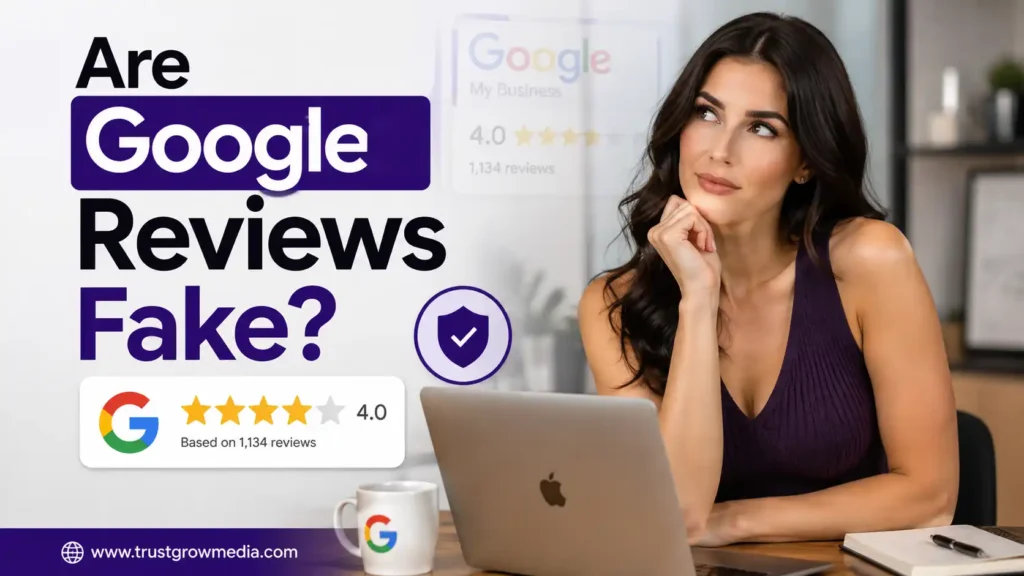
If you have ever wondered, “Are Google Reviews fake?” the short answer is that some are. Not every Google review reflects a real customer experience, and fake reviews can shape a business’s reputation in unfair ways. That matters because online reviews influence what people buy, where they go, and who they trust. The good news is that fake posts often leave clues. Once you know what to watch for, you can read reviews with much more confidence. If you want to better understand review-related risks and protect your online reputation, Trust Grow Media can provide helpful guidance and reputation-focused solutions.
Understanding Fake Google Reviews
Fake reviews are ratings or comments that do not reflect a real customer experience. They may be written to boost a listing or damage a competitor. In both cases, they are a form of review manipulation.
This affects how people use Google reviews and Google Maps when comparing local options. Fake reviewers can distort trust, visibility, and buying decisions. Google does try to detect and remove false content, but the problem has not disappeared. To spot it faster, it helps to understand what makes a review look suspicious.

What Makes a Google Review Fake?
A Google review is fake when it misrepresents a real interaction. That can mean fake positive reviews posted to raise star ratings or fake negative reviews written to harm another company. In simple terms, if the reviewer was not a real customer or the message was designed to manipulate opinion, it is not trustworthy.
You can often tell by taking a closer look at language and review patterns. Genuine reviews usually mention specific details, timing, or staff names. Suspicious ones often feel broad, copied, or exaggerated.
- Extreme claims like “best” or “worst experience”
- Little detail about what actually happened
- Similar wording across such reviews
- Posts that do not match normal customer feedback
If you are asking how to tell if a Google review is fake, start there. Common signs usually sit in the content itself before you even check the reviewer’s profile.
How Widespread Are Fake Reviews on Google?
The problem is large enough to affect how people read Google reviews. Reported review statistics suggest that over 30% of online reviews may be completely fake, while some estimates say up to 50% are manipulated in some way. That helps explain why many shoppers feel uncertain when they compare businesses in search results.
Google has also shown the scale of its enforcement. In 2026, it blocked 170 million fake reviews and improved detection accuracy by 45%. That is a huge number, but it also shows how active the issue remains.
| Measure | What it shows |
| Over 30% of reviews | Estimated to be completely fake |
| Up to 50% of reviews | Estimated to be manipulated in some form |
| 170 million | Fake reviews Google blocked in 2023 |
| 45% higher accuracy | Improvement in Google’s newer detection systems |
So, how widespread is the problem of fake reviews on Google? Wide enough that you should never judge a business by the number of reviews alone.
Why Do Fake Google Reviews Exist?
Reviews influence trust, traffic, and visibility, so some people see fake reviews as a shortcut. A new or struggling company may want faster social proof for its business profile, while a rival may try to drag someone else down.
That is why review manipulation keeps showing up across online reviews. Businesses know ratings can affect sales, customer confidence, and even local visibility. Still, the short-term gain is risky. Google can remove false content, suspend a profile, and trigger bigger problems. Next, let’s look at the motives behind these posts and where they appear most often.
Motivations Behind Posting Fake Reviews
Some businesses get fake Google reviews because reviews directly influence trust. Positive reviews can attract new buyers, especially when a company is just starting out and wants to look established. On the other side, fake negative reviews can be used to lower a competitor’s average rating.
There is also pressure to keep feedback fresh. Many customers want recent opinions, and older comments lose impact quickly. That can tempt people to chase shortcuts instead of earning real customer responses regularly.
- To create quick social proof with positive reviews
- To damage rivals with fake negative reviews
- To avoid slow, honest negative feedback and low review volume
So why do some businesses get fake Google reviews? Usually because reviews affect visibility and trust. The problem is that false posts break rules, can trigger legal action, and often create bigger reputation issues later.
Common Industries Targeted by Fake Reviews
The compiled information does not name one industry as the biggest target. Instead, it shows why many local businesses are vulnerable. Any company that depends on a strong Google business presence, trust, and local search visibility can be affected.
That means fake reviews are not limited to one category. Businesses with a public business profile, a need for steady customer feedback, and heavy dependence on online reviews are common targets.
- New local businesses trying to build trust quickly
- Companies competing for visibility in local search
- Businesses with few reviews on their Google Business listing
- Brands where reputation strongly influences buying decisions
If you are wondering which industries are most affected, the safest answer is broad: many local businesses can be targeted. The pattern depends less on the sector and more on how important reviews are to attracting nearby customers.
Recognizing Signs of Fake Google Reviews
You do not need special software to notice many fake reviews. A suspicious review often stands out when the tone, timing, or account history feels off. This is true for both glowing praise and harsh negative reviews.
On any review platform, context matters. Compare what you read with the rest of the Google Business Profile. Does the language match real customer behavior? Does the complaint mention anything concrete? Once you know the common signs, you can judge posts more carefully instead of reacting to one alarming comment.
Red Flags in Review Content
One of the easiest ways to spot fake reviews is to read the review content closely. Real customers usually describe detailed experiences. They mention what they bought, who helped them, or what went wrong. Fake posts often skip that and lean on emotion alone.
Watch for extreme language. A review packed with exclamation points, broad claims, or dramatic praise can be a red flag. The same goes for vague criticism that never explains the actual problem.
- “Best” or “worst ever” without proof
- No specific details about products, timing, or service
- Copy-like wording that feels generic
- Mentions of competitors or unrelated links
If you ask what common signs might show a Google review is fake, these content clues are a strong starting point. Reviews with balanced, detailed experiences are usually more believable than loud, empty ones.
Suspicious Reviewer Patterns
Content is only part of the story. Fake reviewers often reveal themselves through behavior. If a business gets a sudden influx of reviews in a short period, especially with the same tone or similar wording, that is a strong warning sign.
The reviewer’s profile matters too. Accounts created just to leave one or two reviews, or profiles posting similar reviews for different businesses, deserve extra caution. Genuine users usually have a more natural history.
- Many new reviews appearing in a short period
- Accounts with very low activity or only one post
- Similar comments repeated across different businesses
So, how can you tell if a Google review is fake? Look beyond the words. Review patterns, account history, and the number of reviews posted over time often expose what the text tries to hide.
Impact of Fake Reviews on Businesses and Customers
Fake reviews do more than create annoyance. They can damage a business’s reputation, weaken customer confidence, and make honest companies look untrustworthy. Even genuine feedback can be questioned when people suspect manipulation.
For potential customers, the harm is practical. They may choose the wrong business, avoid a good one, or place trust in misleading online reviews. That affects buying decisions, loyalty, and satisfaction. The next two sections explain how fake feedback hits both companies and the people trying to make smart choices.
Effect on Business Reputation and Revenue
Fake reviews can push a business profile in either direction, but both outcomes carry risk. Fake praise may lift star ratings for a while, while false negative reviews can drag them down fast. Either way, the result is an inaccurate public image.
That matters because reviews influence trust and visibility. Many buyers read several opinions before acting, and strong ratings can support sales. Reviews also shape local search exposure, so manipulation can distort seo efforts and create unstable results.
There is a second layer of damage too. If Google detects fraud, the business may lose those reviews, face profile suspension, or struggle to regain trust. So how do fake Google reviews affect businesses and customers? For businesses, they threaten revenue, search presence, and long-term credibility all at once.
How Fake Reviews Mislead Potential Customers
Potential customers often use reviews as a shortcut for trust. When false reviews appear, that shortcut breaks. Overly polished positive feedback can make a weak business seem reliable, while fake attacks can make a strong one look unsafe.
That leads to poor decisions. A person may book, buy, or visit based on false reviews rather than real customer satisfaction. Others may skip a business that actually delivers good service because the visible comments do not reflect reality.
In the end, fake reviews distort choice. They shift attention away from authentic performance and toward manufactured opinion. For customers, that means wasted money, frustration, and less confidence in online feedback. For businesses, it means earning trust becomes harder even when they do the right thing.
Can You Trust Google Reviews When Choosing a Business?
Yes, but with caution. A Google review can still be useful because many businesses collect real customer opinions, and authentic feedback often reveals patterns you can trust. The key is not to rely on one comment or star ratings alone.
Potential customers should treat online reviews as one signal, not the whole answer. Look for consistency, detail, and recent activity. When several reviews point to the same strengths or problems, they become more helpful. The next sections show how to test reliability and build a balanced view before you choose.

How to Evaluate the Authenticity of Reviews
Google reviews are reliable enough to help when you evaluate them carefully. On any review platform, trust grows when comments appear naturally over time and include specific details. A business with authentic reviews regularly looks different from one with sudden bursts of vague praise.
Take a wider view before deciding. Read beyond the top comments, compare dates, and check whether the feedback sounds like real use of the service. Google My Business listings with a steady stream of believable comments are often easier to trust.
- Look for specific details, not generic praise
- Check whether reviews appear regularly
- Compare recent comments with older ones
- Read more than the average rating alone
So, are Google reviews reliable enough to trust when choosing a business? Yes, if you test them for consistency and context instead of taking every post at face value.
Building a Balanced Perspective with Online Feedback
The safest approach is to build a balanced perspective. Google reviews work best when you read them as a group. One angry post or one glowing comment rarely tells the full story. Repeated themes matter more than isolated reactions.
Negative reviews are not always a bad sign. In fact, a mix of praise and criticism can make customer feedback feel more real. If every review sounds perfect, caution makes sense. If several people mention the same issue in different ways, that is more useful.
So how can you trust Google reviews when choosing a business? Focus on patterns, detail, and recency. Balanced online reviews usually give a clearer picture than extreme opinions, and they help you separate honest experiences from likely manipulation.
Tools and Methods for Detecting Fake Google Reviews
There is no single magic test for fake reviews, but there are useful ways to spot them. Google relies on automated solutions, while everyday users can look for timing, wording, and account behavior. Both approaches focus on review patterns.
You can also compare what you see with broader review statistics and common warning signs. Some suspicious posts even mention competitors or external websites, which can make the problem easier to identify. Let’s break this into two parts: tools that scan for fraud and manual checks you can do yourself.
Automated Solutions to Spot Fraudulent Reviews
Google does use automated solutions to catch fake reviews more easily. Its systems analyze behavior and signals that point to review manipulation. The company has said its newer algorithm is better at identifying suspicious activity and removing policy-violating content quickly.
These systems do not just read the words. They also look for patterns that humans may miss, such as bursts of posting activity or other technical signals tied to coordinated behavior. The compiled information says Google blocked 170 million fake reviews in 2023.
- Algorithm checks for similar wording and timing patterns
- Systems flag suspicious activity for further investigation
- Technical signals may include behavioral data such as IP address clues
So yes, there are tools and methods to help spot fake Google reviews easily. Google’s own automated systems do a lot of the heavy lifting, even if they cannot catch everything right away.
Manual Review Techniques Every Consumer Should Know
You can do a lot with simple manual checks. Start by scanning the Google Business Profile as a whole, not just one comment. Look for natural variety in tone, timing, and detail. A healthy profile usually shows mixed but believable experiences over time.
Then read closely. Fake reviews often lack detailed experiences, show repeated phrasing, or arrive all at once. When several warning signs appear together, your confidence should drop.
- Check for a sudden influx of reviews
- Compare wording across multiple posts
- Look for missing details about the visit or purchase
- Review the account history when possible
Are there tools or methods to help spot fake Google reviews easily? Yes, and manual review is one of them. A few minutes of careful reading can reveal review patterns that make suspicious content much easier to spot.
Dealing with Fake Google Reviews: Reporting, Removal, and Prevention
If you find fake reviews, do not ignore them. Google’s policies allow reporting of suspicious content, and that is usually the first step toward cleanup. For business owners, acting early can limit damage to trust and visibility.
Prevention matters too. Review manipulation becomes less effective when a profile collects steady, authentic feedback instead of relying on big gaps and silence. Whether you manage your own listing or watch reviews as a customer, knowing how reporting and removal work helps you respond with less stress and more control.
Step-by-Step Guide to Reporting a Fake Review
If you spot fake reviews, reporting them is a good idea. Google gives business owners and users a direct way to flag suspicious content. The process can start from Google Search or through the managed business account on the review platform.
Keep it simple and follow the available menu options carefully. Before you submit anything, read the policy so you choose the right violation type. That improves the odds of a clean review.
- Search for the business and open Read Reviews
- Find the review and click the Info icon
- Select the violation type and submit
- In a managed profile, open Reviews and choose Flag as inappropriate
What steps can you take to report a fake Google review? These are the main ones. For repeated attacks, document timing and patterns so you can support your reporting with clearer evidence.
How Google Handles and Removes Fake Reviews
Yes, fake Google reviews can be removed. Google handles them in two main ways: automated spam detection and user reports. If the system or a reviewer flags content that breaks Google’s policies, it can be reviewed and taken down.
This process can also carry bigger consequences for businesses that abuse reviews. A Google business listing may face suspension, and in serious cases there may be fines or legal action under U.S. consumer protection rules. That raises the cost of manipulation far beyond one bad post.
- Automated systems detect suspicious behavior and wording
- Reported content is reviewed for policy violations
- Review removal may be followed by profile penalties
Does Google do enough to stop fake reviews on its platform? It does a lot, including blocking massive numbers of false posts, but the ongoing volume shows no system is perfect. Vigilant users still matter.
Conclusion
In conclusion, understanding the nuances of Google reviews is essential for both businesses and consumers. While genuine feedback can significantly influence purchasing decisions, the presence of fake reviews poses a substantial challenge. Recognizing the signs of fraudulent reviews and knowing how to evaluate their authenticity can empower you to make more informed choices. By leveraging tools and techniques for detecting these deceptive practices, you can protect your business reputation and ensure that customers have access to trustworthy information. If you want to learn more about navigating the world of online reviews effectively, feel free to reach out for guidance!